What Are Inversions in Music?
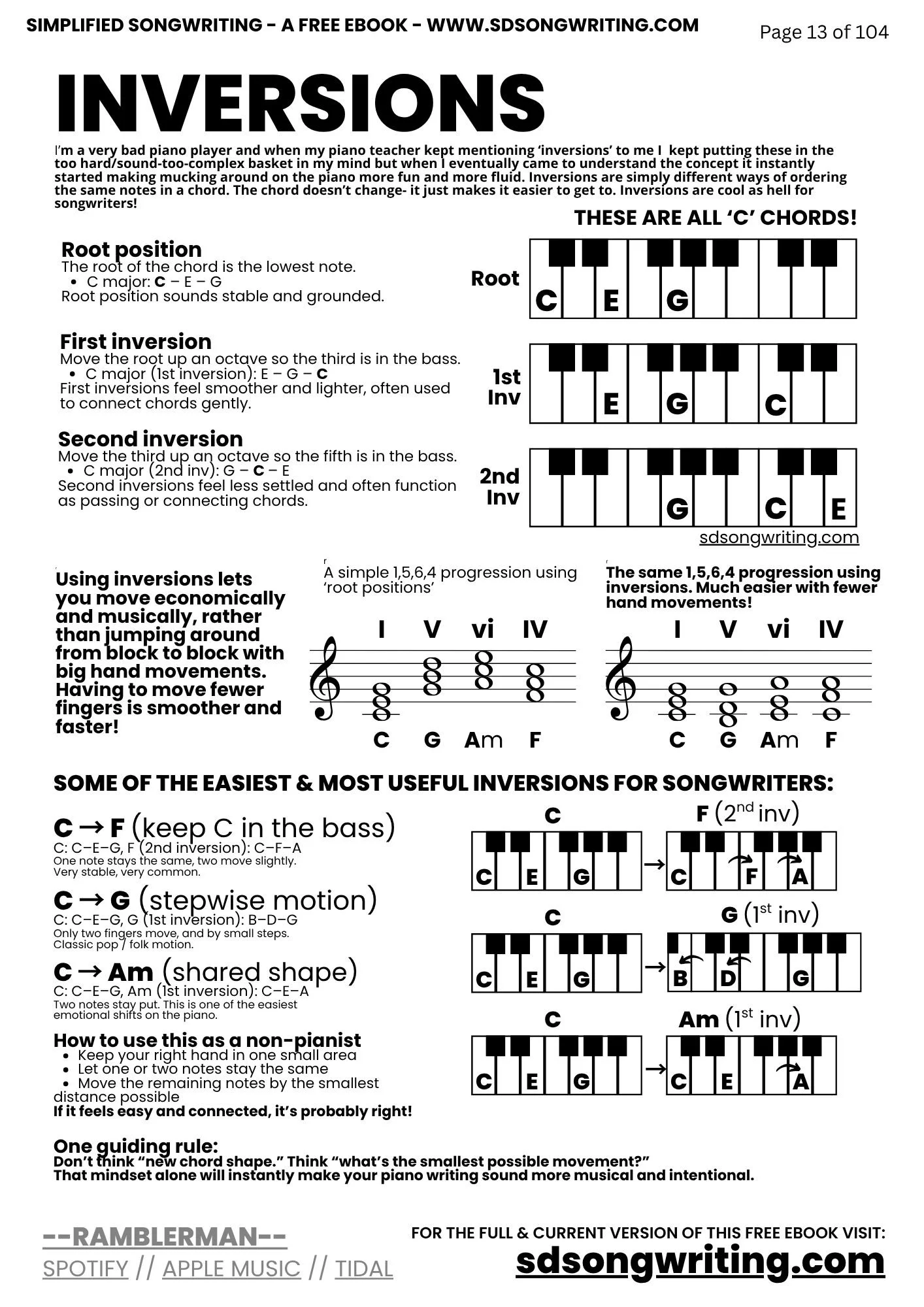
An inversion is simply a different way of arranging the same notes.
Nothing new is added.
Nothing is taken away.
The notes stay the same — they’re just reordered.
Inversions mainly apply to chords, and they help music sound smoother, more interesting, and less jumpy.
Start With a Basic Chord (C Major)
Let’s begin with a familiar example: C major.
A C major chord is made from three notes:
C – E – G
This is called the root position of the chord.
C is the root (the note the chord is named after)
E is the third
G is the fifth
When C is the lowest note, the chord is in root position.
What Does “Lowest Note” Mean?
The lowest note is simply the note that sounds the deepest or bass-like.
This matters because:
Our ears strongly focus on the lowest note
Changing the lowest note can change how stable or tense a chord feels
Inversions are all about which note is on the bottom.
First Inversion (C Major)
In the first inversion, we move the root (C) up an octave, so it’s no longer the lowest note.
The notes become:
E – G – C
Same three notes.
Different order.
Now:
E is the lowest note
The chord still sounds like C major
But it feels a little lighter and less grounded
This is called C major, first inversion.
Second Inversion (C Major)
In the second inversion, we move the next lowest note (E) up an octave.
The notes become:
G – C – E
Now:
G is the lowest note
The chord feels more open or suspended
It often wants to move somewhere else
This is called C major, second inversion.
Why Use Inversions at All?
Inversions exist for musical flow, not theory for theory’s sake.
Here’s why they’re useful:
1. Smoother Chord Changes
Instead of jumping all over the instrument, inversions let chords move by small steps.
Your hands move less
Your music sounds more connected
2. Better Bass Lines
Inversions let you choose which note is in the bass.
That means the bass can:
Walk smoothly
Create melodies of its own
Avoid repeating the same note over and over
3. Subtle Emotional Shifts
Even though the chord name stays the same:
Root position feels stable and settled
First inversion feels gentler or more reflective
Second inversion feels floating or unresolved
Songwriters use this all the time, often without knowing the theory name.
Inversions Don’t Change the Chord’s Identity
This is important:
C – E – G
E – G – C
G – C – E
All of these are C major.
The function of the chord stays the same.
Only the feel and movement change.
Inversions on Instruments (Quick Notes)
On piano: inversions are very visual — you’re literally rearranging fingers
On guitar: you’ve probably been using inversions without realising
(most open chords already include inverted notes)
If you’ve ever played a chord where the lowest string isn’t the root — congratulations, you’ve used an inversion.
How Inversions Fit Into the Bigger Picture
Notes are the raw materials
Chords group notes together
Inversions rearrange those notes
Progressions become smoother and more musical
Inversions are one of the simplest ways to make music sound more intentional and professional without learning new chords.